
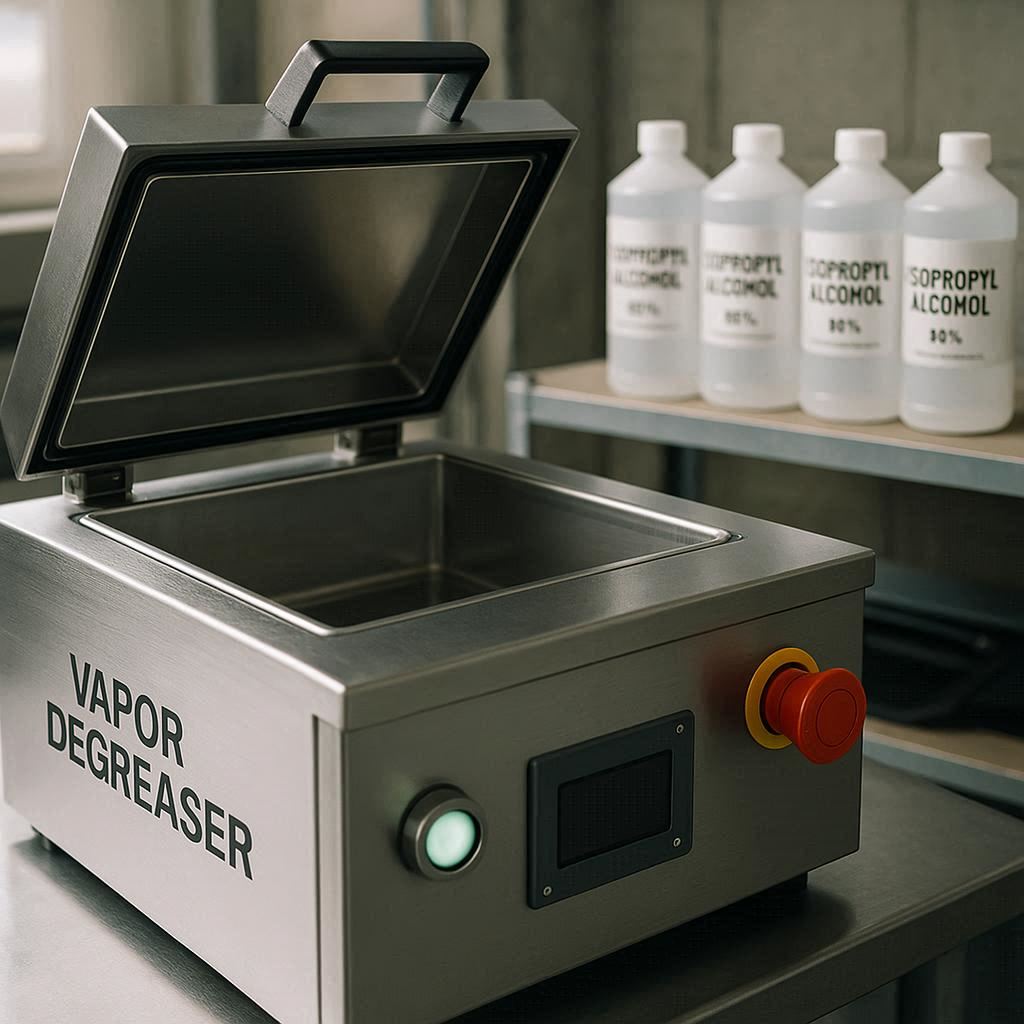
Industries rely on vapor degreasing to clean precision parts. The process uses solvent vapors to dissolve oils, flux, and other contaminants. Traditionally, companies used chlorinated solvents like trichloroethylene (TCE) or perchloroethylene (PCE). These solvents worked well because they were non‑flammable and powerful. However, environmental regulations and health concerns pushed industries to search for safer alternatives.
Isopropyl alcohol (IPA) emerged as a candidate. Manufacturers already use IPA widely in electronics, medical devices, and optics. But can IPA function inside a vapor degreaser? The answer is yes—if you follow strict safety rules. IPA’s flammability and water absorption demand specialized equipment and careful handling. This article explains how IPA works in vapor degreasing, outlines risks and benefits, and answers common questions.
What Is Vapor Degreasing?
Vapor degreasing cleans parts by condensing hot solvent vapors on cooler surfaces. The condensed solvent dissolves contaminants and carries them away.
Steps in vapor degreasing:
- Operators heat solvent until it boils.
- Vapor rises into the chamber.
- Parts enter the vapor zone.
- Solvent condenses on parts and dissolves residues.
- Contaminants drip back into the sump.
- Solvent evaporates, leaving clean, dry parts.
This method excels at cleaning complex geometries where liquid scrubbing cannot reach.
Properties of Isopropyl Alcohol
- Formula: C₃H₈O
- Boiling point: ~82.6°C (180.7°F)
- Flashpoint: ~53°F (11.7°C) → highly flammable
- Polarity: dissolves oils, flux, and residues effectively
- Hygroscopic nature: absorbs water from air, reducing cleaning efficiency
These traits make IPA effective but challenging inside vapor degreasers.
Can IPA Be Used in Vapor Degreasers?
Yes, under strict conditions:
- Use explosion‑proof equipment. IPA vapors ignite easily, so only Class 1, Division 2 (C1D2) or airless vacuum vapor degreasers work safely.
- Maintain closed systems. IPA absorbs water, so open systems dilute cleaning power.
- Follow safety protocols. Operators must ensure ventilation, grounding, and fire suppression.
No, in unsafe setups:
- Avoid open‑top degreasers. Fire hazards rise instantly.
- Avoid uncontrolled environments. Moisture and ignition risks increase.
Advantages of IPA in Vapor Degreasing
- Leaves no residue.
- Dries quickly, reducing cycle times.
- Protects delicate materials like electronics and optics.
- Provides a safer environmental profile than chlorinated solvents.
- Cleans complex geometries effectively.
Risks and Challenges
- Fire hazard: IPA vapors ignite at room temperature.
- Water absorption: Dilutes cleaning strength.
- Static discharge: Sparks can ignite vapors.
- Health risks: IPA irritates eyes, skin, and lungs.
- Regulatory compliance: OSHA and NFPA standards apply.
Best Practices for Using IPA in Vapor Degreasers
- Operate only closed, explosion‑proof systems.
- Monitor solvent purity and replace IPA when water content rises.
- Train operators thoroughly in safety procedures.
- Combine IPA with ultrasonics for stronger cleaning.
- Maintain ventilation to prevent vapor buildup.
- Store IPA in sealed containers away from heat.
Applications of IPA Vapor Degreasing
- Electronics: Removes flux from circuit boards.
- Medical devices: Cleans surgical tools and implants.
- Optics: Polishes lenses and precision glass.
- Aerospace: Degreases delicate components.
- Laboratories: Sterilizes glassware and instruments.
Comparison: IPA vs. Traditional Solvents
| Feature | Isopropyl Alcohol (IPA) | Chlorinated Solvents (TCE, PCE) |
|---|---|---|
| Flammability | High | Non‑flammable |
| Residue | None | Minimal |
| Environmental Impact | Safer | Hazardous |
| Equipment Needs | Explosion‑proof | Standard |
| Applications | Electronics, optics, medical | Heavy‑duty degreasing |
FAQs: IPA in Vapor Degreasers
1. Can I use IPA in any vapor degreaser?
No. Only explosion‑proof or airless vacuum systems handle IPA safely.
2. Why does IPA pose fire risks?
Its flashpoint sits at ~53°F, so vapors ignite easily at room temperature.
3. Does IPA leave residue?
No. IPA evaporates cleanly, making it ideal for precision cleaning.
4. Which industries use IPA vapor degreasing?
Electronics, medical devices, optics, and aerospace.
5. Can IPA absorb water?
Yes. IPA is hygroscopic, so closed systems preserve purity.
6. Is IPA safer than chlorinated solvents?
Environmentally, yes. But flammability makes IPA riskier without proper equipment.
7. How often should operators replace IPA?
Replace IPA when water content rises or cleaning efficiency drops.
8. Can IPA pair with ultrasonics?
Yes. Ultrasonics enhance IPA’s cleaning power.
9. What happens if IPA enters open‑top degreasers?
Fire or explosion risks increase dramatically.
10. Does regulation cover IPA use?
Yes. OSHA, NFPA, and local fire codes apply.
Conclusion
Industries can use isopropyl alcohol in vapor degreasers, but only under strict safety conditions. IPA’s flammability and water absorption make open systems unsafe. In C1D2‑rated or airless vacuum vapor degreasers, IPA delivers residue‑free, fast‑drying, and environmentally safer cleaning.
Electronics, optics, and medical industries benefit most from IPA’s precision cleaning. Success depends on equipment design, operator training, and solvent monitoring. When companies follow these rules, IPA becomes a powerful alternative to chlorinated solvents.
Final Takeaway:
Yes, IPA works in vapor degreasers—but only in specialized, explosion‑proof systems. It offers excellent precision cleaning but demands strict adherence to safety protocols.

My name is Logan, and I’m a 36-year-old dad who owns a small pressure-washing company in the suburbs of Atlanta, Georgia. My main goal with rubbing-alcohol.com is to show you how versatile isopropyl rubbing alcohol can be! I hope. You find it useful.